
Reef Gardens
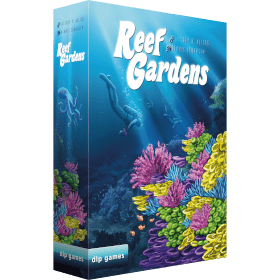 As courageous marine conservationists, in Reef Gardens you dive into the dazzling world of coral reefs and take on the mission to save these vital ecosystems. With a skillful hand, you plant new corals and create thriving reef landscapes while the clock ticks and the budget dwindles. To get more research money, you may have to part with existing reefs from time to time so that new ones can be planted.
Használd bölcsen a korlátozott erőforrásaidat, mert a természetvédelem néha nehéz kompromisszumokkal jár...
Játékosok száma: 2 - 4
Játékhossz: 43 mn
Bonyolultság: 2 / 5
Játssz Reef Gardens-t és 1377 egyéb játékot!
Letöltés nem szükséges, közvetlenül a böngésződből játszható.
A barátaiddal és több ezer játékossal az egész világról.
Ingyenes.


Játssz Reef Gardens-t és 1377 egyéb játékot!
Letöltés nem szükséges, közvetlenül a böngésződből játszható.
A barátaiddal és több ezer játékossal az egész világról.
Ingyenes.
Szabályösszefoglaló
Game overview:
The aim is to plant corals on the seabed in such a way that they score as many victory points as possible. Points are scored for each coral tile planted and, if applicable, for shell tiles.
Points are also awarded to the players who have the largest adjacent coral reefs when the underwater stations are scored. You need research funds (money) to create new reefs which can be obtained by closing your own reefs.
Turn:
On your turn, choose between the two available actions: Planting or Surfacing. Passing is not allowed.
Action: Planting:
Select a row in the underwater nursery and take all the coral tiles there. You must pay 1 money for each coral tile you acquire. If you do not have enough money to purchase the complete row, you cannot choose the row. You must always take all coral tiles in a row and plant them immediately. Coral tiles that you cannot or do not want to plant are discarded from the game. You lose 3 points for each coral tile you discard.
After you have taken tiles, if there are only 3 or fewer coral tiles left in the nursery, a new underwater station will appear on the map and the nursery will be refilled with new coral tiles.
When Planting, you can also use any number of your collected shell tiles before, during or after the action for the associated bonus.
Planting rules:
- Coral reefs may only be planted on free spaces or spaces containing shell tiles. This means that no tiles may be planted on caves or building sites reserved for underwater stations.
- A new coral reef must always start at an underwater station. To do this the first tile of the new reef must be placed on one of the four starting spaces orthogonally adjacent to an underwater station.
- Existing coral reefs that you already own can be extended by placing tiles of the same type orthogonally adjacent to each other (side by side, not diagonally).
- A player’s own coral reef may not be connected to another player’s coral reef of the same type.
When you start a new reef at an underwater station, you take one of your divers from the player board and place it on the tile. If you extend your own reef (marked with a diver) with a coral tile of the same type, you do not have to place another diver on it. On each connected reef, only one diver marks who owns the reef. The reef background also marks the owner on BGA.
As soon as you close a reef with the Surfacing action, it becomes neutral. Neutral reefs do not belong to anyone, but they can become the property of a player when merged.
Fusion with own or neutral coral reefs:
Coral reefs of the same coral species can be merged under certain circumstances:
- If you connect 2 of your own coral reefs of the same type, both reefs are merged and one of the divers is immediately returned to your player board. You do not receive any new research funds for taking the diver back.
- You can merge your own reef with a neutral reef of the same type, provided that the neutral reef —before it is merged— is the same size or smaller than your own reef. However, if the neutral reef is larger, the two reefs may not be merged.
- If you can connect several neutral reefs to your own at the same time, the condition must be met for each individual reef. Your own reef must therefore be larger or the same size as each individual neutral reef. If one of the neutral reefs is larger than your own, the reefs cannot be merged.
If you place a coral tile on a space containing a shell tile, you take this tile and place it face up in front of you. Some of the shell tiles allow additional actions. You can use these tiles in any number and in any order during the Planting action. The tile that you used to perform an action is then removed from the game.
Scoring after Planting:
After you have performed the Planting action, you must check whether an underwater station will be scored.
- If, at the end of a turn, all 8 spaces around an underwater station are occupied (by coral or shell tiles or by spaces showing a cave), this underwater station is scored.
- Now determine which player has the most coral tiles in all their reefs adjacent to this underwater station, including diagonally. To do this, first check which reefs occupied by divers are connected to the underwater station, i.e., which have at least one tile adjacent to the station on one of the 8 surrounding spaces. Neutral reefs are ignored. Then, for each player, count the coral tiles on their reefs. If a player has multiple reefs adjacent to the underwater station, the tiles from all reefs are added together.
- Whoever has the most coral tiles belonging to reefs adjacent to the underwater station receives the higher value indicated on the underwater station. The player with the second most coral tiles receives the lower value indicated. If more players have adjacent coral reefs, but they are not as large, they do not score any points.
- If several players are tied for the most coral tiles, they all receive the higher score. The score for 2nd place is then omitted. If there are several players who are tied for the second most coral tiles, they all receive the lower score.
- If only one player has coral tiles adjacent to the underwater station, they only receive the higher point value.
After an underwater station has been scored, the station tile is turned over so that it cannot be scored again.
Action: Surfacing:
Instead of planting, if you own at least one coral reef, you can also close any number of your own reefs and retrieve their divers by selecting the Surfacing action. This will give you new research funds.
Close and score coral reef:
- Remove your diver from the reef you are closing and put him back on your player board.
- You receive 1 victory point for each coral tile of a reef that you close. You receive 1 additional victory point for each clownfish in your closed reef.
The closed coral reefs remain on the seabed. They do not belong to anyone and are considered neutral. No further coral tiles can be added to neutral reefs. However, they can be taken over again through merging and expanded again after that.
Research funds:
If you choose the Surfacing action, you must close at least one reef, but you may close as many of your own reefs as you like. You will now receive new research funds. These are based on the number of divers on your player board at the end of this action. The more divers you have on your board, the more money you receive, according to the table below:
- 1 diver 2 money
- 2 divers 4 money
- 3 divers 6 money
- 4 divers 7 money
- 5 divers 8 money
The maximum amount of funds is 12. Any income above this is forfeited.
End of game:
The game ends when the underwater nursery is empty and can no longer be refilled. Final scoring follows:
- All underwater stations that have not yet been completely surrounded are now scored. The player with the most coral tiles in their reefs adjacent to a station receives the lower point value on the station tile. Any other players with reefs adjacent to this station receive no points. If there are several players tied for the most coral tiles, they each receive the lower score.
- All coral reefs on which you have divers are scored. Count the coral tiles on your reefs and score 1 victory point per tile. Then add an additional point for each tile with a clownfish.
- Finally, you receive 1 victory point for each shell tile in front of you. Shoal tiles instead score the number of points printed on them.